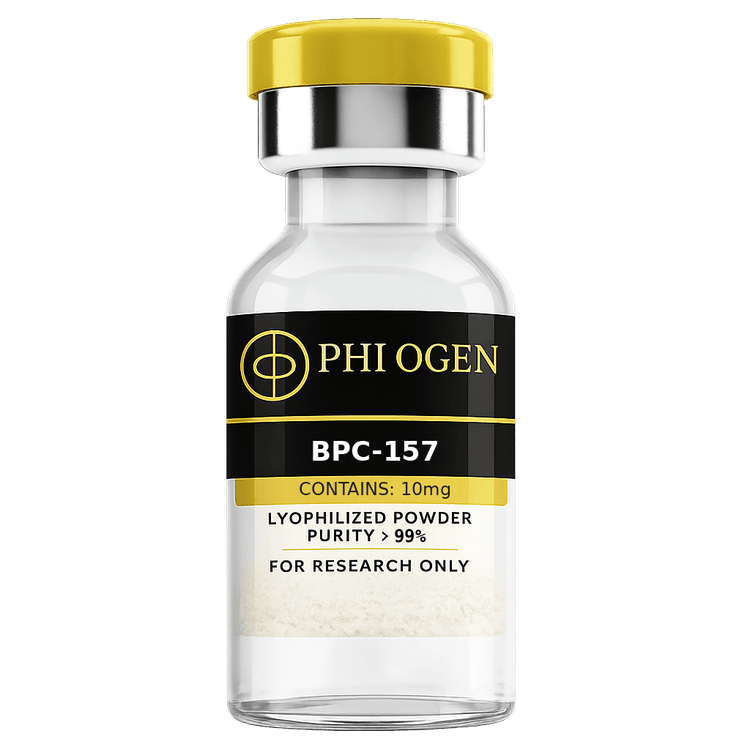
The Healing Pentadecapeptide
Buy BPC-157
Not For Human Use, Lab Use Only.
15-amino-acid partial sequence of Body Protection Compound — the most studied tissue-repair peptide in research. Over 100 published studies covering tendon, GI, muscle, bone, and nerve repair.
≥98% Purity
HPLC Verified
Research Grade
Lyophilized
Fast Shipping
Free $200+
Specifications
BPC-157 — Signaling & Cellular Response
- 1
Nitric Oxide Pathway Upregulation
BPC-157 activates eNOS (endothelial nitric oxide synthase), increasing local NO production and driving vasodilation and angiogenesis at injury sites. This improves blood flow and delivery of repair substrates — a rate-limiting factor in tendon and ligament healing.
- 2
Growth Factor Upregulation (VEGF, EGF, PDGF)
BPC-157 upregulates key growth factors at injury sites, driving angiogenesis and cell proliferation. VEGF drives new blood vessel formation; EGF drives epithelial repair; PDGF recruits fibroblasts for collagen synthesis.
- 3
FAK-Paxillin Signaling
BPC-157 activates focal adhesion kinase (FAK) and paxillin, regulating fibroblast migration to injury sites — a prerequisite for collagen deposition and tissue remodeling in tendons and ligaments.
- 4
Gastroprotection & Gut-Brain Axis
BPC-157 was first identified as an endogenous gastroprotective factor. It reverses NSAID and alcohol-induced GI damage, modulates the dopaminergic and serotonergic systems, and protects the intestinal epithelial barrier.
BPC-157 — Pair This With
TB-500
BPC-157 drives local angiogenesis and growth factor upregulation. TB-500 drives systemic cell migration through actin regulation. The two work on complementary pathways — the most studied healing peptide stack.
GHK-Cu
GHK-Cu adds collagen and elastin synthesis on top of BPC-157's repair signaling — particularly useful for skin and soft tissue applications requiring structural rebuild.
Buying BPC-157: Vial Math & Handling
Illustrative ranges from published laboratory work—reference only, not a protocol for use.
Subcutaneous Injection
200–800 mcg/day
Once or twice daily
Most common protocol. Inject proximal to injury site when possible.
Oral
10–100 mcg/kg
Once daily
Maintains efficacy in GI models despite gastric environment. Studied for gut-specific applications.
BPC-157 — Dissolution Profile
10mg + 2mL BAC water = 5,000 mcg/mL. For a 250–500 mcg dose draw 0.05–0.1mL on an insulin syringe.
BPC-157 is small (~1.4 kDa) and dissolves almost immediately. Post-reconstitution stable at 2–8°C for ~4 weeks; more heat-tolerant than most peptides.
BPC-157 — Catalog Disclaimer
This page summarizes identity, purity, and handling context for catalog navigation. It is not medical advice, a drug label, or a summary of clinical outcomes for any use. Materials are sold for legitimate laboratory research only; verify requirements with your institution and the supplier.
Peptides to Buy With BPC-157
BPC-157
from $53.99