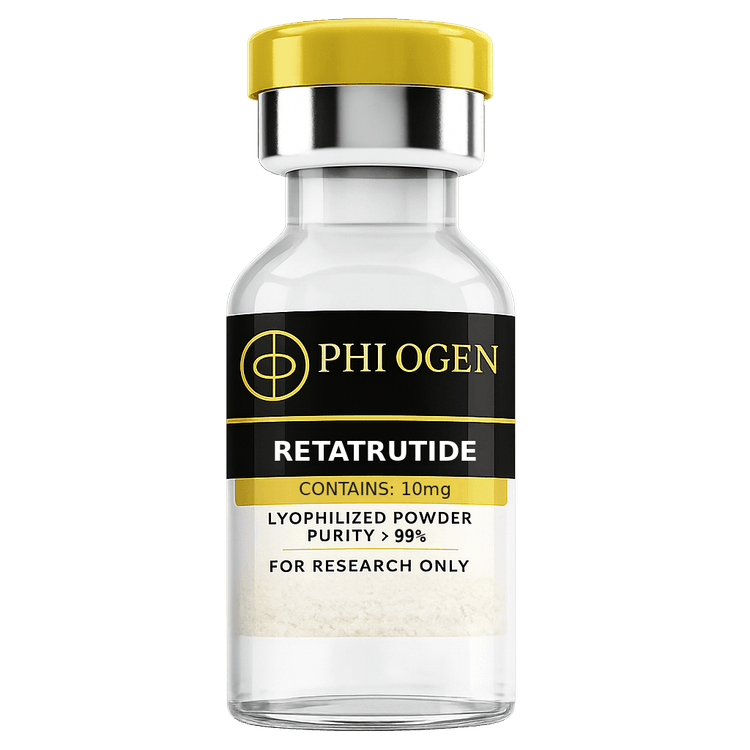
Triple-Agonist GLP-1 / GIP / Glucagon
Buy Retatrutide
Not For Human Use, Lab Use Only.
Triple incretin/glucagon receptor pharmacology—listed here as a research-grade lyophilized SKU with supplier-stated purity.
≥98% Purity
HPLC Verified
Research Grade
Lyophilized
Fast Shipping
Free $200+
Specifications
Retatrutide — Mechanism of Action
GLP-1 Receptor Agonism — Appetite & Insulin
Retatrutide activates GLP-1 receptors in the hypothalamus, reducing appetite and caloric intake. It also potentiates glucose-dependent insulin secretion and suppresses glucagon — the same pathway exploited by semaglutide, but as one component of a three-part mechanism.
GIP Receptor Agonism — Adipose & Insulin Sensitization
GIP receptor signaling is discussed in incretin pharmacology as influencing adipose and beta-cell biology alongside GLP-1. Mechanistic reviews are the right place for pathway detail; this page does not summarize comparative human weight-change outcomes.
Glucagon Receptor Agonism — Energy Expenditure
The glucagon receptor arm differentiates retatrutide from dual incretin designs in receptor coverage. Hepatic glucagon signaling is linked in the literature to glucose and lipid turnover; we do not quote human energy-balance or weight-loss deltas on this storefront.
Liver Signaling (Preclinical / Literature)
Published work discusses glucagon and GLP-1 family signaling in hepatic lipid handling; specific magnitudes and human outcome claims belong in primary literature, not on this catalog page.
Retatrutide — Important Notice
This page summarizes identity, purity, and handling context for catalog navigation. It is not medical advice, a drug label, or a summary of clinical outcomes for any use. Materials are sold for legitimate laboratory research only; verify requirements with your institution and the supplier.
Buying Retatrutide: Concentration Reference
Figures below are volumetric / handling notes for lyophilized material only. They are not therapeutic dosing, efficacy claims, or instructions for use in humans or animals.
Retatrutide — Reconstitution Notes
10mg vial + 2mL BAC water = 5mg/mL (5,000 mcg/mL). Example draws: 0.8mL = 4mg; 1.6mL = 8mg—solution math only.
Retatrutide is a lipidated GLP-3 analog — allow 2–5 min of gentle swirling for full dissolution. Post-reconstitution stable at 2–8°C for 4 weeks.
Retatrutide — Pair This With
BPC-157
BPC-157 is commonly discussed in tissue-repair literature alongside metabolic research programs; pairing rationale here is descriptive, not an outcome claim.
GHK-Cu
GHK-Cu is widely studied in dermal remodeling literature; many buyers keep it in the same cart for unrelated skin-research workflows.
TB-500
TB-500 (thymosin beta-4 fragment) appears in connective-tissue repair literature as a separate research line from incretin pharmacology.
Peptides to Buy With Retatrutide
Retatrutide
from $134.99